Seabird Restoration Overview and Goals

The Aleutian Islands provide critical habitat for millions of seabirds in the North Pacific Ocean. However, on Rat Island, in the western Aleutians, invasive rats are preventing all but a very small number of seabirds from breeding on the island. The U.S. Fish and Wildlife Service, The Nature Conservancy, and Island Conservation are partnering together to remove rats from Rat Island in order to protect seabirds and restore the natural habitat.

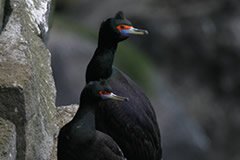
Red Faced CormorantsIntroduced non-native rats have been responsible for about half of all recorded bird extinctions globally. On Rat Island, they have eliminated virtually all seabirds and many other birds. There are no native land mammals on Rat Island so the birds had no natural defenses against these aggressive predators. Also, on the treeless Aleutians, birds must nest on the ground, in burrows or on cliffs. Most of these nesting sites are easily accessible to rats.

Restoring the natural habitat will likely bring back Tufted Puffins, Storm Petrels, Song Sparrows, Glaucous-Winged Gulls, Ancient Murrelets, and so many other important breeding seabirds for. Overall, the project will benefit at least 26 species of breeding birds, including at least 13 seabird species, some of which currently breed in small numbers on Rat Island or are restricted to breeding on small offshore islets. Additionally, the restoration of Rat Island's breeding habitat will make it possible for additional seabird species that breed on nearby islands and likely bred on Rat Island as well before rats were introduced to re-establish breeding colonies there.

Additionally, the Rat Island project will set the groundwork for similar conservation projects in the future throughout the Aleutian Islands, allowing project leaders to adapt proven conservation techniques to the Aleutian environment and build upon lessons learned to restore multiple, successively larger islands in the future. The Rat Island project will be the third-largest island rat eradication ever attempted and the first of its kind in the Aleutian archipelago.

Goals

The U.S. Fish and Wildlife Service, The Nature Conservancy, and Island Conservation are collaborating to restore nearly 7000 acres of potential seabird habitat on Rat Island by removing invasive rats. We expect this to facilitate restoration of the natural island ecosystem and improve habitat quality for the island's native species, such as the Whiskered Auklet, Horned Puffin, and Leach's Storm Petrol, along with others.

Specifically, we expect seabird species that likely nested on Rat Island before rats were introduced to return to the island and begin breeding successfully again.

The specific goals of the project are to:

  • Restore the natural habitat of Rat Island by removing invasive rats
  • Adapt removal methods that have been extensively proven in other regions of the globe to be effective in the Aleutians environment
  • Set the groundwork for future conservation projects in the Aleutians through technique development; personnel training; local, national, and international partnerships; and vendor relationships

Rat Island's habitat for native plants and animals, particularly seabird species that have largely been prevented from successfully nesting since rats were introduced, is expected to improve significantly. Biological surveys have confirmed that seabirds are breeding on small islets directly offshore (less than 800 m) from Rat Island, but many of these seabird species are absent from Rat Island itself despite abundant suitable habitat. Restoring the main island will create opportunity for seabirds to recolonize areas previously used for nesting. Many other bird species, including waterfowl and landbirds, are known to breed in small numbers on Rat Island itself as well as on some offshore islets. Restoring Rat Island will similarly improve nesting habitat and opportunities for these species.